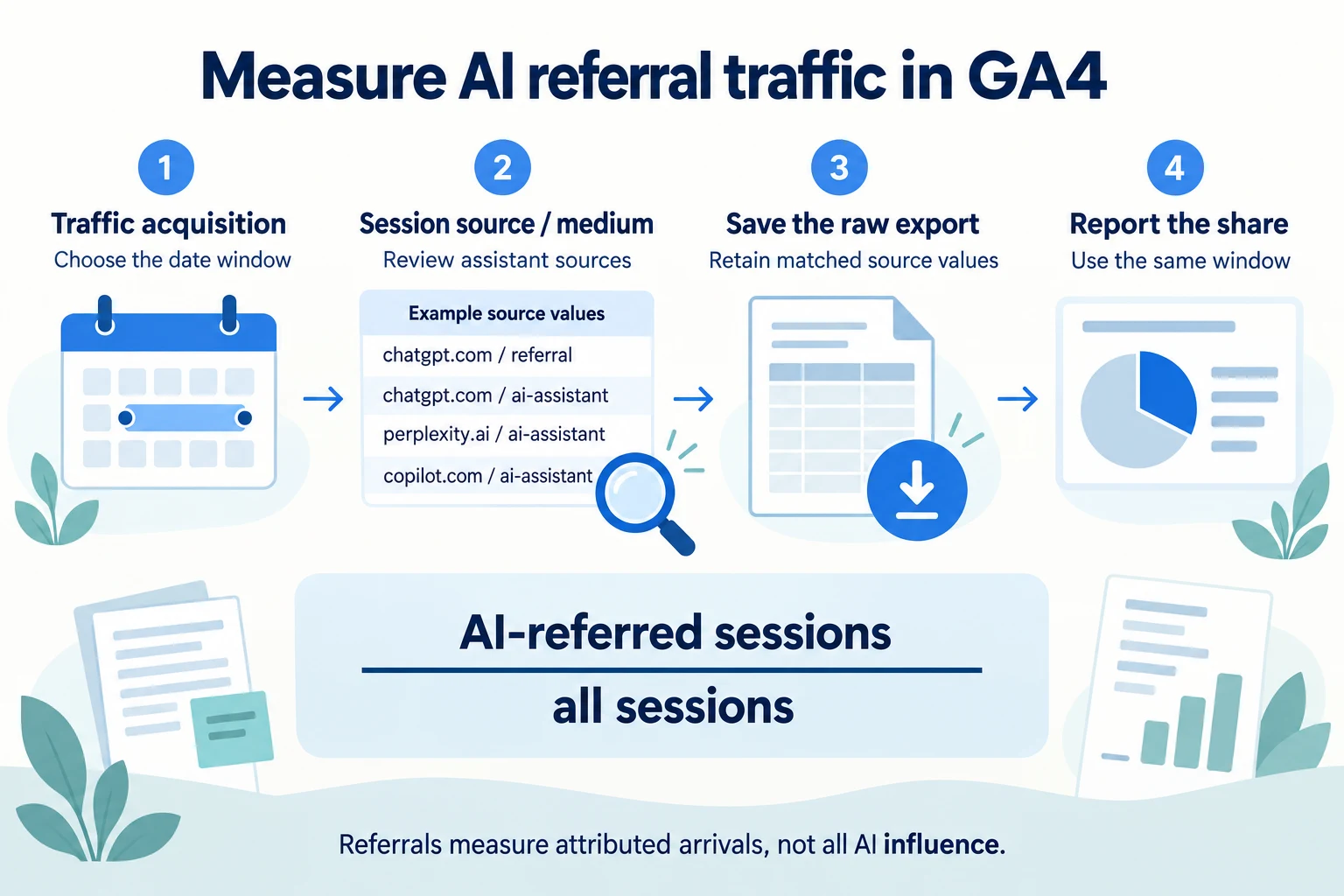
To track AI referral traffic in GA4, use the Traffic acquisition report with Session source / medium, review source values for recognizable assistant domains, and preserve the date window and total sessions beside the AI-referred count.
This measures human visits GA4 attributed to an assistant source. It does not measure AI crawler activity, unclicked brand mentions, or every visit influenced by an AI answer.
The fastest GA4 workflow
In your GA4 property:
- Open Reports.
- Go to Acquisition → Traffic acquisition.
- Set the date range you intend to report and record both boundary dates.
- Change the primary dimension to Session source / medium. If it is not immediately visible, use the dimension selector above the first column.
- Review or filter the source values for recognizable assistant names and domains.
- Keep Sessions in the report. Add or retain Engaged sessions, Engagement rate, Key events, and landing-page detail only when they answer a defined question.
- Use the report’s share/download control to export a CSV before doing further classification.
Google’s Traffic acquisition documentation defines Session source / medium as the source and medium associated with a new session. That session scope is why this report is a better starting point than the User acquisition report, whose dimensions describe how a user was first acquired.
Source / medium strings to look for
Referral values vary with the referring product, redirects, and manual campaign tagging. Do not require one universal medium. Brandvane’s maintained GA4 fixtures exercise strings that actually occur in supported exports, including:
| Session source / medium value | How to classify it |
|---|---|
chatgpt.com / referral | ChatGPT-referred session |
chatgpt.com / ai-assistant | ChatGPT source with a manually assigned medium |
perplexity.ai / ai-assistant | Perplexity source with a manually assigned medium |
copilot.com / ai-assistant | Copilot source with a manually assigned medium |
Your property may show other domain variants and the standard referral medium. Search the source text for recognizable markers rather than assuming every assistant uses / referral forever.
Brandvane’s classifier currently recognizes source text containing ChatGPT, OpenAI, Perplexity, Copilot, Claude, Gemini, You.com, Poe, DeepSeek, Meta AI, Mistral, Grok, or xAI variants. Gemini is named here only as a possible GA4 referral source. Brandvane does not sample it as a tracked answer engine.
A practical case-insensitive source-matching expression for an Exploration, spreadsheet, or warehouse workflow is:
chatgpt|openai|perplexity|copilot|claude|gemini|you\.com|poe\.com|deepseek|meta\.ai|mistral|grok|x\.aiTest the expression against your raw values and retain the matched rows. A future product or domain change will require the list to be updated.
Preserve the denominator
The headline should use all recorded sessions from the same GA4 export and date window:
AI-referred session share = matched AI-referred sessions / all sessions
Report the fraction beside any percentage:
GA4 recorded 24 AI-referred sessions out of 2,400 total sessions during the selected window.
Do not compare AI referrals from one window with total traffic from another. Do not replace zero with “no AI visibility.” Zero matched referrals means GA4 recorded no matched referred sessions in that export. An assistant could still have mentioned the brand without a click, or a person could have arrived later through direct or branded search.
Add landing pages and outcomes
Once the source baseline is reliable, ask what happened after arrival. Add Landing page + query string as a secondary dimension or build an Exploration using:
- Session source / medium;
- Landing page + query string;
- Sessions;
- Engaged sessions or engagement rate;
- Key events; and
- revenue only if the property is configured well enough to support the claim.
Keep counts with their denominators. “AI-referred visitors engaged at 70%” is incomplete without the number of AI-referred sessions and the definition GA4 used. Small channels can swing sharply when one session changes.
A landing-page view can show which pages received recorded referrals. It cannot reveal the exact prompt, answer, or citation that produced each visit unless another controlled mechanism supplies that context.
Bot filtering: what GA4 does and does not do
Google says known bot and spider traffic is automatically excluded using Google research and an IAB-maintained list. The setting cannot currently be disabled, and GA4 does not show how much known-bot traffic it removed.
That does not turn GA4 into a crawler-log system. Many crawlers do not create ordinary browser sessions, and a GA4 session row cannot verify the identity or purpose of a crawler. Use server, CDN, or edge logs when the question is whether identified infrastructure requested a URL.
Clean human noise separately:
- configure internal traffic rules for staff and agency activity;
- use test mode before activating an internal-traffic data filter;
- remember that active exclusion is permanent for incoming data; and
- use the unwanted-referrals setting for self-referrals or third-party systems such as payment processors—not to erase legitimate assistant referrals.
Google’s data-filter documentation notes that filters act from creation forward and excluded data is not recoverable in Analytics. Its unwanted-referrals guide explains that the feature changes referral attribution; it is not a bot blocklist.
Common attribution traps
Using First user source instead of Session source
User acquisition answers how a user was first acquired. Traffic acquisition answers what originated the session. For recurring referral reporting, label and use the session-scoped dimension.
Searching only for referral
Manual tagging can produce another medium, while the source still identifies the assistant. Match and retain the full source / medium value.
Treating direct traffic as non-AI traffic
GA4 uses (direct) / (none) when it lacks clear source information. Privacy controls, apps, redirects, copied links, and later direct visits can break the attributable path. Direct is unknown origin, not proof of no AI influence.
Removing assistants as unwanted referrals
If the assistant genuinely sent the visitor, excluding that domain destroys the source signal you are trying to measure. Reserve unwanted-referral rules for domains that should not start a new referral attribution, such as parts of your own transaction flow.
Calling a referral a conversion
A session proves an attributed arrival. It does not prove a lead or sale. Use configured key events or revenue fields for those claims and retain their counts.
What AI referral data cannot show
GA4 cannot show:
- an assistant mention or citation that received no click;
- the full population of answers buyers saw;
- verified AI crawler access;
- influence that later appears as direct or branded-search traffic;
- sessions blocked by consent choices or client-side measurement failures; or
- the exact answer that caused a visit in an ordinary referral report.
It can show AI-referred human visits recorded under recognizable source values. That is valuable precisely because the claim is bounded.
How Brandvane measures AI visibility explains how to keep referrals separate from sampled answers and verified access. To calculate the baseline without building filters, use the free AI traffic analytics report: export the Traffic acquisition CSV, upload it locally, and the file stays in your browser.
For the evidence framework, see how Brandvane measures AI visibility. Automated weekly AI reports for ChatGPT and Google AI Overviews are coming soon; the planned reports will keep the two surfaces separate and show completed-check counts.
A monthly reporting template
Report the exact window, matched source values, AI-referred sessions out of all sessions, leading landing pages, engagement or key events when configured, and changes to the classifier or GA setup. Save the raw export so a reviewer can reproduce the total.
The result is not “all traffic caused by AI.” It is a smaller and defensible statement: the human visits GA4 recorded as arriving from recognizable AI-assistant sources during a disclosed window.