We ran our own product against our own site and it told us we were invisible in AI answers. A GA4 export with overlapping dates attributed roughly a quarter of recorded sessions to recognizable AI-assistant sources.
Both numbers were correct. The disagreement was the finding.
This is a first-party case study on a site we own, not a client engagement. The historical panel described below is not an included automatic feature of current SEO or Pro+ subscriptions. LaserBurnAI is one of our own properties. Its referral destinations led us to revisit the coverage of our selected questions.
Editorial clarification (12 September 2026): the original video below uses stronger shorthand about the questions people asked. GA4 does not reveal those prompts, and the two data windows differ by one day. The updated explanation and infographic preserve these limits; no later comparison result has been added.
See where your brand stands How we measure
Read the transcript
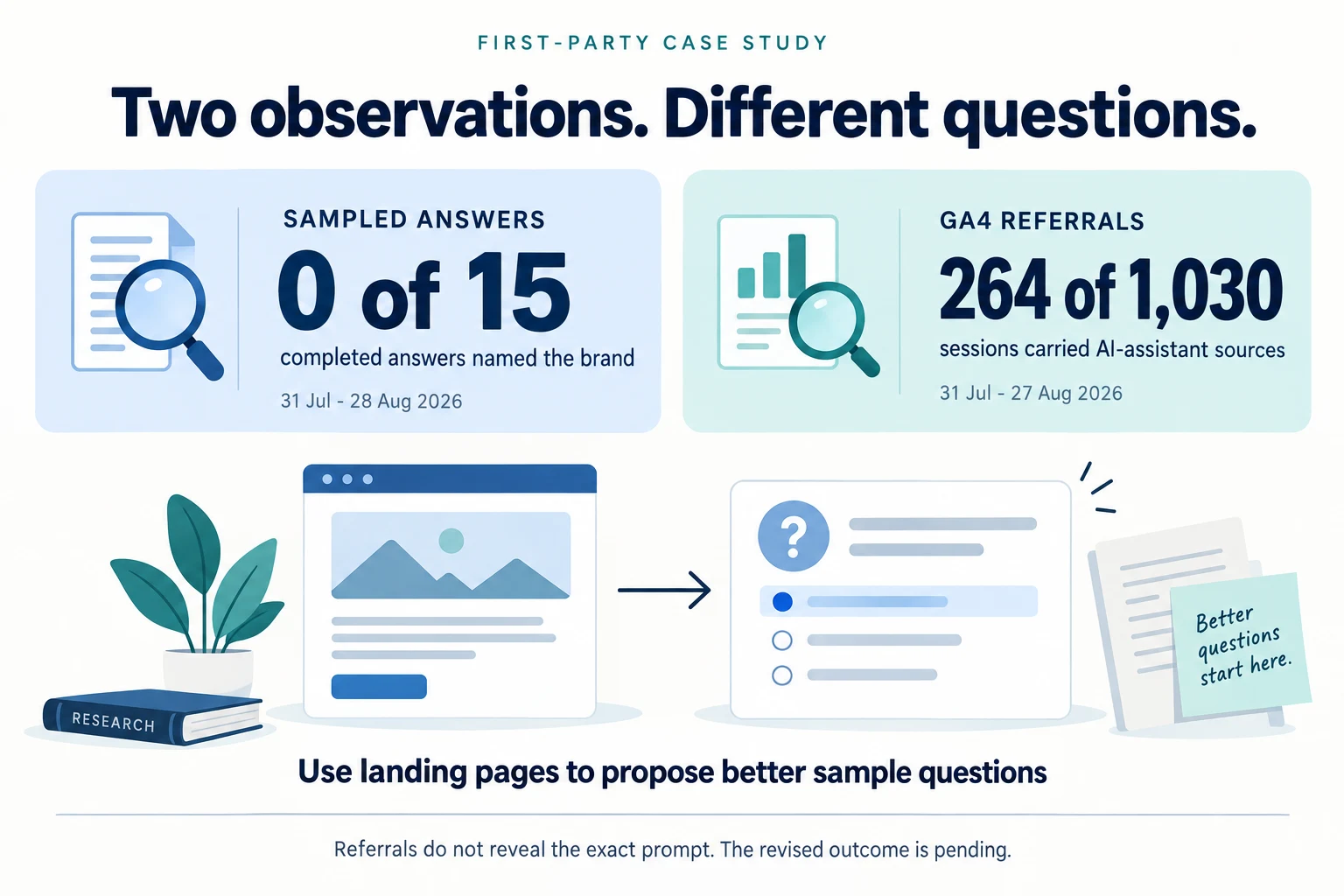
We ran our own product against our own site, and it said we were invisible in AI answers. Zero out of fifteen.
Same window, our analytics said 264 of 1,030 sessions came from AI assistants. A quarter of the traffic.
Both numbers were right. Nothing was broken. We were just asking the wrong questions.
The landing pages gave it away. Nobody was arriving on a generic convert-your-photo page. They were landing on specific tools.
So we rebuilt the question set from the landing pages instead of from our own marketing. The page someone lands on is the question they asked.
One signal would have sent us chasing the wrong problem for a quarter. See where your brand stands, free, at brandvane.ai.
The two numbers
The answer-sampling window was 31 July – 28 August 2026. The GA4 export covered 31 July – 27 August 2026. These windows overlap but are not identical; the counts also describe different events.
| Observation | Result |
|---|---|
| Sampled answers including the brand | 0 of 15 |
| Planned samples that returned an answer | 15 of 15 |
| Sampled answers carrying provider citations | 14 of 15 |
| AI-referred human sessions (GA4, 31 Jul – 27 Aug) | 264 of 1,030 |
The sampled-answer side was clean. Fifteen of fifteen planned samples completed across OpenAI, Anthropic and Perplexity — no failures, no cap skips, nothing hidden in the denominator. Fourteen of the fifteen answers came back carrying the providers’ own citations, so the engines were sourcing normally.
The brand appeared in none of them.
Meanwhile GA4 recorded 264 AI-referred sessions out of 1,030 total. Just over a quarter of everything.
Why the obvious reading was wrong
The obvious reading of “0 of 15” is: the brand has no authority in this category, so go build some. That is what our own report said to do. Its recommended bearing was build authority.
The referral count made that diagnosis too confident. Zero appearances described our 15 completed answers; it did not establish absence across unobserved answers. GA4 attributed arrivals to assistant sources, without showing the answers behind those visits. That disagreement gave us a reason to review the prompt panel.
The questions became our next hypothesis to test.
The prompt panel had been written the way most prompt panels get written: from how we describe the product. LaserBurnAI converts images into laser-ready engraving files, so the questions asked assistants about converting a photo into an engraving file — the generic job, phrased the way a vendor phrases it.
The available data did not establish how often people asked those generic questions.
What the landing pages said
The correction did not come from thinking harder about the prompts. It came from the traffic.
GA4 records which page an AI-referred visitor arrives on. For this window, ranked by AI-referred sessions:
/tools/single-line-art/(home)/tools/box-generator/tools/image-to-heightmap/tools/nesting/tools/png-to-svg/tools/layered-slicer
These landing pages suggested narrower tasks worth including in the panel: creating single line art, generating a finger-jointed box, or turning an image into a heightmap. The referrals identified destinations, not the exact questions or recommendations that preceded them.
The landing page is evidence for a candidate question. It shows where a recorded visit arrived. It does not reveal the visitor’s exact prompt, the full answer, or why a link was selected. Use those destinations to propose questions, then test and version the panel.
What we changed
We deactivated two of the three original prompts, kept the one that still described a real question, and added seven new ones derived from the landing pages above — clustered around single line art, the box generator, heightmaps, nesting, vector conversion, and the layered slicer.
We changed the instrument. We did not touch the site, publish anything, or pursue a single citation.
What this case study does not establish
The correction is not a result. At the time of writing, the corrected panel has not completed a full comparison window, so there is no after-number to report and no claim that the change improved anything.
It also does not establish that:
- the brand is well represented in AI answers. The old panel recorded valid observations for its disclosed questions. Its coverage of the tasks suggested by referral landing pages was limited; the new panel might still show few appearances.
- 264 of 1,030 was caused by AI recommendations. It is a count of sessions carrying recognizable AI-assistant referrers in one property, in one window. Referral data has its own limits, and a referral is not proof of a specific answer.
- this generalizes. One site, one window, one category. A site with genuinely thin authority would produce the same
0 of 15for the opposite reason, and the referral lane is exactly what tells the two apart.
The honest summary is narrower than the story: first-party referrals exposed a possible gap in our sampling design, and we revised the panel to investigate it. The outcome is pending.
Why a single lane could not have caught this
Sampled answers alone said build authority. Referral data alone said things are working. Each lane answers a different question. Neither alone justified a broad conclusion about authority or business success.
The disagreement is what carried the information. That is the entire argument for keeping three evidence lanes separate — what AI systems say, what verified infrastructure does, and whether people arrive — and reconciling them rather than compressing them into one score. A composite number would have averaged this finding out of existence.
It is also why a missing lane has to stay visibly missing. If the GA4 connection had not been in place, the report would have said build authority with nothing to contradict it, and we would have spent a quarter chasing citations for questions nobody asks.
The rule worth taking
Use AI-referral landing pages alongside customer questions and search evidence to improve your prompt panel.
Concretely:
- Pull AI-referred sessions by landing page for the last complete window.
- For each page with meaningful volume, propose a question that page answers — in the words a buyer would use, not the words your marketing uses.
- Version the panel, record what you deactivated and why, and keep the old results rather than deleting them.
- Re-sample on the same schedule and report the fraction with its denominator.
- Treat a disagreement between lanes as a finding, not an error to reconcile away.
If you have no AI referral traffic yet, this technique is unavailable to you, and a panel written from positioning is a reasonable starting point — provided you treat its first results as a hypothesis about the questions rather than a verdict on the brand.
The failure mode this prevents is the expensive one: a confident report, a clear recommendation, and a quarter of work aimed at the wrong problem.