Local SEO for electricians starts with a clear connection between what your business does, where it operates and how someone can contact you. A useful program improves those basics, measures actual inquiries and uses the findings to choose the next piece of work.
Begin with your Google Business Profile, the pages describing your most important services, and the path from a website visit to an estimate request. This guide explains a practical sequence for an electrical contractor with an existing website and one operating location.
Free resource · No signup required
Electrician website checklist
Use these ten checks with your existing website. Mark what needs attention, then choose one useful fix. This is a planning aid for an electrical contracting business, not a ranking score or an electrical installation guide.
Download the free one-page checklist (PDF) ↗ Link to this checklist
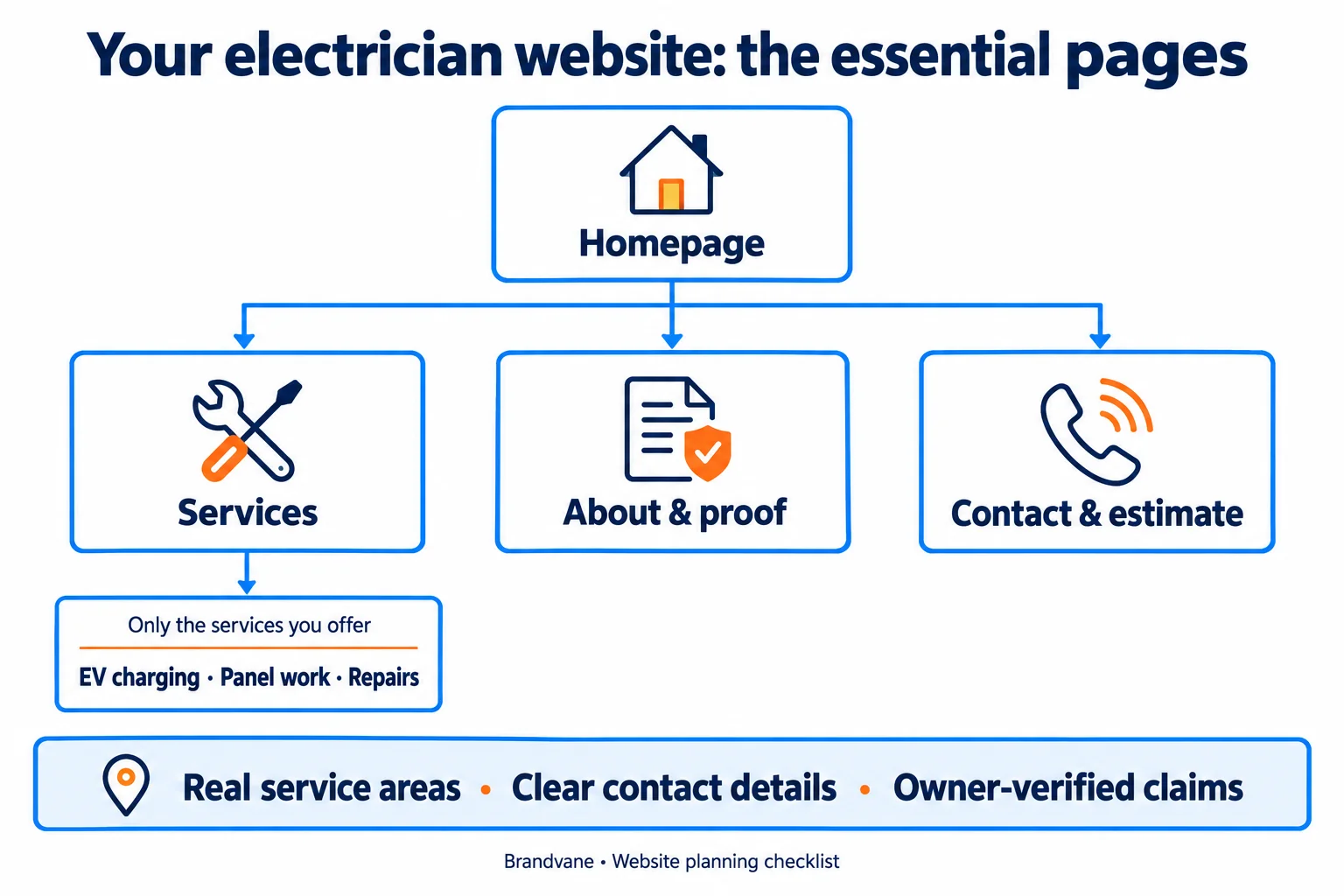
Make the homepage specific
Can a visitor tell what you do, where you work and how to contact you?
A good result: Name the electrical work you offer, your real service area and a clear call or estimate action.
Choose the right service pages
Does each priority service have a useful place on the site?
A good result: Give distinct customer needs their own page when justified. Combine overlapping services and leave out work you do not offer.
Answer the next customer question
Does the service page explain what happens after an inquiry?
A good result: Describe your actual scope, assessment process, information to provide and next step. Avoid unsupported price or availability promises.
Show accurate service areas
Can the customer tell whether you serve their location?
A good result: List genuine coverage and practical limits. Add town pages only when you have useful, specific information for those places.
Use real proof
Can readers check the experience and claims you present?
A good result: Use owner-approved project examples, permitted photos and accurate credentials. Publish customer feedback only with appropriate permission.
Label and connect your pages
Are titles clear, and can visitors reach important pages?
A good result: Use descriptive page titles and headings. Link relevant services from navigation and related pages; check for broken links.
Keep the Business Profile accurate
Does your eligible Google Business Profile match the real business?
A good result: Check name, phone, hours, website and categories. If customers do not visit your address, follow service-area rules.
Check the mobile experience
Can you read and use the page on a phone?
A good result: Use legible text and clear buttons, avoid obstructive overlays, compress oversized images and check that pages load without errors.
Test the contact path
Does an estimate request reach the right person?
A good result: Tap the phone link and submit a labeled test form. Confirm receipt, response ownership and a useful confirmation message.
Record a baseline and the next action
Can you tell what changed after you update the site?
A good result: Record the date, page, change and Search Console observations. Track qualified inquiries separately from clicks; do not assume causation.
A service-page outline: before and after
This fictional example shows how to make a page more useful. It describes a proposed rewrite, not measured SEO results. Use an EV page only if your business offers that work.
Before: a generic service mention
- Heading: “Our services”
- One sentence listing EV chargers alongside every other job
- “Quality work at competitive prices” with no supporting detail
- A contact link with no explanation of the next step
After: a clear EV installation page
- Heading: “EV charger installation in [actual service area]”
- Installation work offered and who it is suitable for
- What the customer should provide and how your assessment works
- A genuine project example or other owner-verified proof
- Process questions, with technical claims reviewed by a qualified person
- “Request an EV installation assessment,” linked to a working form
Your first action: choose one service you want to grow, compare its page with the outline, and record the three most useful changes. Ask the owner to verify the facts before publishing.
Prefer a broader set of AI marketing instructions? The optional free marketing skills pack is delivered by email. No signup is needed to use this checklist or its printable PDF.
Understand the two places you can appear
Local Maps results and ordinary organic website results are different surfaces. A Business Profile helps people find business information in Google Search and Maps. A website page can appear among organic results for a relevant search. One position does not establish your visibility everywhere in a city.
Google describes local ranking in terms of relevance, distance and prominence. Keep your information accurate, but recognize that a searcher’s location and competing businesses affect what appears. Google’s local ranking guidance
An ordinary keyword rank report is not a citywide Maps report. If you later use a local grid tool, preserve the search locations, search terms and dates so comparisons mean something. For a first assessment, record the search context and treat each observation as a snapshot.
1. Start with the electrical services you actually want to grow
List the jobs your business wants and can deliver. Possible examples include panel upgrades, EV charger installation, generator installation or commercial electrical maintenance. These are planning examples, not verified keyword demand for your area.
For each service, record the area you serve, how you assess a job, the questions prospects ask and the page currently explaining it. Review existing inquiries and Search Console data before deciding what to publish. A service that generates good work but has a weak page may deserve attention before a higher-volume phrase with a poor business fit.
| Customer task | A useful page | What the page needs |
|---|---|---|
| Request a panel-upgrade assessment | Electrical panel upgrades | Actual scope, service area, assessment process, project evidence and contact action |
| Find an EV charger installer | EV charger installation | Services offered, what information to provide, real project details and the next step |
| Arrange ongoing commercial support | Commercial electrical services | Types of work accepted, location coverage and a suitable inquiry route |
Do not publish a page for every keyword variation. “Electrical panel replacement” and “panel upgrade” may belong together if they describe the same customer task and your search-result review supports that grouping. Our small-business keyword research guide explains how to turn related phrases into a page plan.
2. Check your Google Business Profile against the real business
Confirm that the profile reflects your actual business name, contact details, website, opening hours and services. Choose categories that accurately describe the business. Add current photos you have permission to use and review information when the business changes.
If you travel to customers and do not receive customers at your address, follow Google’s service-area business rules. Do not create fictional offices to appear in nearby cities. Google’s business representation guidelines
Use the same core business details on your website and important business listings. Investigate incorrect phone numbers, old addresses and duplicate information. A large directory-submission count is less useful than accurate information where prospective customers actually encounter your business.
3. Improve one important service page
A service page should help a potential customer decide whether to contact you. Give it a specific title, explain the service in plain language and make the next step easy to find on a phone.
An illustrative EV charger page could include:
- What installation work the business offers and where it operates.
- How an initial assessment works and what information a customer should provide.
- Owner-verified project photos and descriptions, used with permission.
- Common questions about the process, answered by the business.
- A clear estimate request and a working phone link.
Keep technical claims accurate and have a qualified person review them. Do not turn a marketing page into an unsupported electrical installation tutorial. Avoid invented credentials, customer quotes, job photos or experience.
As a worked example, imagine a site where EV charger installation appears only as one line on the home page. A dedicated service page may help visitors understand the offer. First check whether customers need that information, whether the business offers the service, and what competing results show. Then draft, review and publish. That is a proposed improvement, not evidence that it will produce a particular number of leads.
4. Make service-area information useful
Explain the locations you genuinely serve and any practical limits. Your contact page and relevant service pages should help someone understand whether you can take their job.
A separate town page needs a reason to exist: distinct service information, real local work or answers that matter to customers there. Repeating the same page with a different city name is unlikely to be useful to a reader. Google’s content guidance emphasizes original information and content created for an intended audience. Google’s people-first content guidance
For a small site, start with a clear service-area section. Add another page when you can make it meaningfully helpful and maintain it.
5. Ask for honest reviews after genuine work
Make it easy for customers to leave feedback after a completed job. A short request with the business’s review link is a practical starting point. Ask consistently for an honest account of the experience; do not offer a discount or gift in exchange for a review. Google’s review-request guidance
An example request:
Thank you for choosing us for your electrical work. If you’d like to share your experience, you can leave an honest review here: [your business review link]. We appreciate your feedback.
Reply thoughtfully and avoid disclosing private job or customer details. Review activity is one part of a broader local presence; it does not guarantee a specific position.
6. Check the route from a visit to an inquiry
Open the important pages on a phone. Can you read the service description, identify the area served, tap the phone number and complete the form? Submit a known test inquiry and verify it reaches the person responsible for responding.
| Observation | What it tells you | What it does not prove |
|---|---|---|
| Search impression | Your page was shown in a search result | Someone visited or needed your service |
| Organic click | Someone clicked through from search | A qualified lead or booked job |
| Phone-button click | Someone tapped the contact action | A connected call |
| Connected call or form | An inquiry reached the business | The inquiry was suitable or became a job |
| Qualified inquiry and booked work | The business confirmed the next stage | That one SEO change caused the result |
Use Search Console for search exposure and clicks, website analytics for on-site activity, and your own records to classify leads and booked work. Document filters and date ranges when comparing periods. Google’s Search Console performance report documentation
Exclude known test submissions and spam. Keep other changes in view: advertising, demand shifts, weather, response times and staffing can all affect inquiry and booking patterns. If call tracking is used, agree on the setup and usage limits before depending on the report.
A manageable first month
Week one: collect access, review existing inquiries, identify a priority service and record the starting measurements.
Week two: correct inaccurate business information and inspect your most important page and contact path.
Week three: improve that page using accurate business details. Have the owner review it, publish it and test the form and phone action.
Week four: document completed work, compare observations carefully and choose the next two page priorities. A short period may establish a baseline without showing a reliable trend.
Should you do it yourself or use managed SEO?
Do it yourself when you have time to investigate the evidence, edit your website and maintain the work. Brandvane’s SEO and Pro+ software plans support keyword and competitor research; you handle the implementation. Country-level estimates do not establish demand in your town, and ordinary search snapshots do not replace Maps grid tracking.
Choose managed help when you want someone to prioritize and implement the program. Brandvane’s electrician SEO service is $1,500 per month for the defined one-location scope, on a month-to-month basis. It includes page work, local maintenance and monthly reporting. A fit review checks your website and needs before any commitment.
How long does electrician local SEO take?
Implementation can begin once access and accurate business information are available. Visibility and business outcomes depend on the starting site, local competition, location and demand. A first month is useful for setting a baseline and completing work; it is not a dependable deadline for rankings or leads.
Do electricians need a page for every service and town?
Create pages around distinct customer needs that you can explain well. Begin with the most important services and honest coverage information. Separate geographic pages require useful, specific content; a long list of interchangeable pages is not the goal.
Is a higher ranking enough to measure success?
Keep rankings as supporting evidence. What matters commercially is whether relevant people reach the business and become suitable inquiries or jobs. Record those stages rather than treating a ranking movement as revenue.