Small-business keyword research should end with a short list of useful pages you can make. A spreadsheet with thousands of phrases is only helpful if it changes what you publish, improve or offer a customer.
Begin with one product or service, a defined audience and a market you actually serve. Then gather customer language, check demand and search results, and assign each distinct task to a page. This process works for an established business and for a new website with little search data.
Start with the questions customers already ask
Write down the language from sales conversations, support messages and product enquiries. Remove private customer details before sharing examples with an assistant. Useful questions include what the product fits, what it costs, how it differs from another option and what happens after purchase.
For an illustrative shop selling handmade desk lamps, the list might include “wooden desk lamp,” “desk lamp for a small desk” and “how to choose warm desk lighting.” These are seed ideas, not verified search volumes.
For a service business, include the service area when it affects who can buy. A nationwide keyword estimate will not tell you the demand in a particular town. Brandvane’s country-level research and ordinary Google snapshots do not replace a local map-grid tracking tool.
Use existing search evidence when you have it
If the site is already receiving impressions, review its Search Console performance by query and page. Identify pages that are being shown for relevant searches and questions that appear repeatedly. Google’s performance report documentation explains the available metrics and filtering.
Use this as evidence about your own website’s search exposure. It is not a complete competitor database. Query lists can omit data, and page-level and property-level totals may differ; do not force all exports to add up as though they use identical aggregation.
For a new website, start from customer tasks and competitor pages instead. You do not need to wait for Search Console impressions to write a clear product page, explain your service or answer a recurring buying question.
Expand a few seeds, then filter for business fit
Look up related phrases in a keyword research tool. Keep the country and language consistent, retain the raw export and distinguish an unavailable metric from zero. If using Brandvane, a quoted keyword request returns up to 25 related phrases; you can review a small batch before expanding further.
Ask three questions of every candidate:
- Can the person searching this become a customer, or get meaningful help from our expertise?
- Can we produce the page they need with the products, knowledge and evidence we have?
- Is there an existing page we should improve instead of creating another?
A phrase can have modest estimated demand and still describe an important buying decision. A popular phrase about a service you do not provide is less useful. Difficulty is one input; it does not tell you whether your page will satisfy the reader.
Check intent and assign the page
Review Google results for your shortlist. Record which kinds of pages recur and whether the same exact URLs appear across related queries. This gives you a reason to combine variants or keep tasks separate.
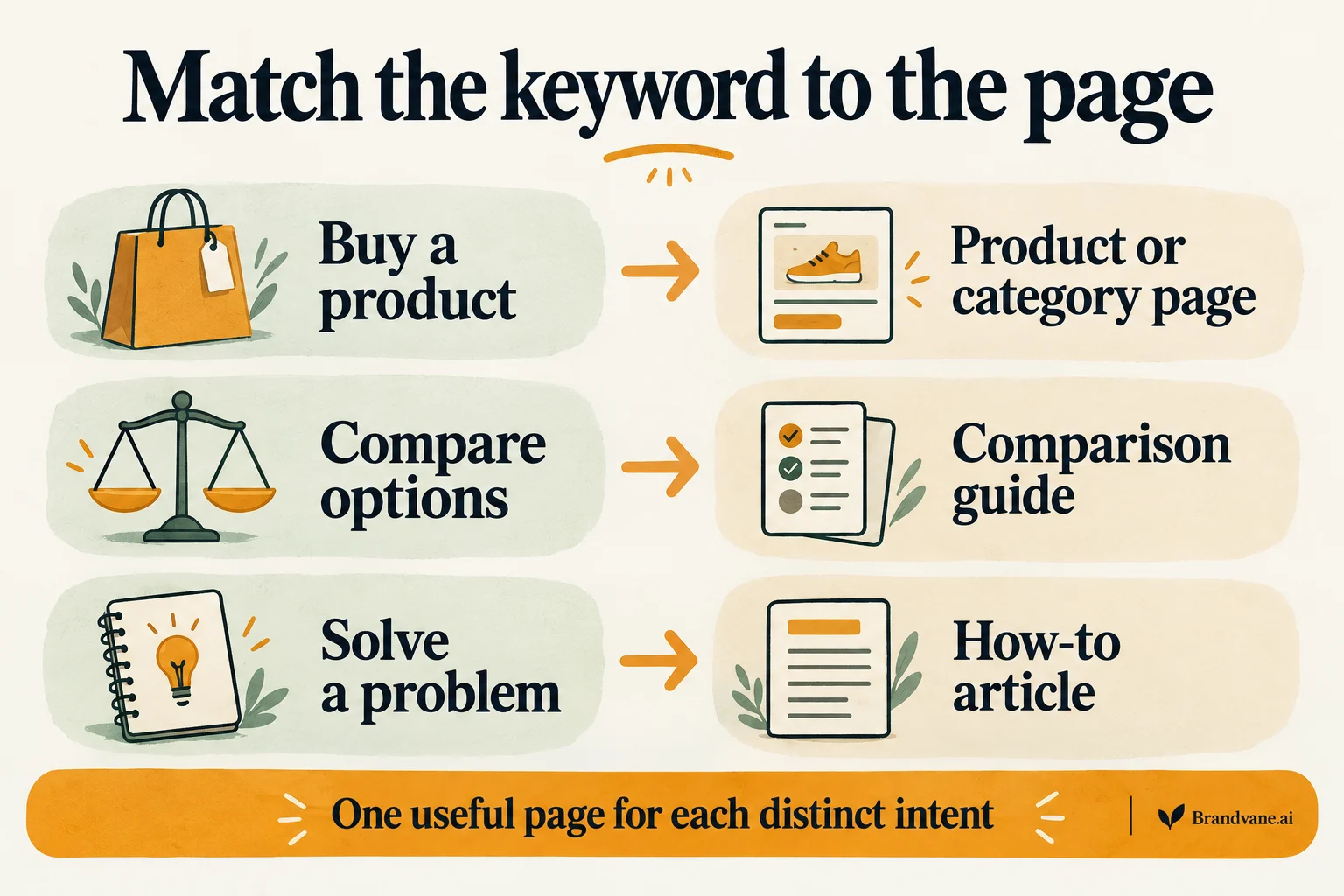
Here is an illustrative page map. Confirm the actual search intent before using it for a real shop:
| Candidate phrase | Customer task | Possible destination |
|---|---|---|
| Wooden desk lamps | Browse a product type | Collection page with available products |
| Wooden vs metal desk lamp | Compare materials | Guide with practical trade-offs |
| How to choose a desk lamp for a small desk | Work through a constraint | Tutorial with dimensions and examples |
| Lamp delivery and returns | Resolve a purchase concern | Clear shipping and returns information |
The last row can be essential even without a keyword tool showing demand. Your site must answer purchase questions as well as attract new visitors.
How to find lower-competition opportunities
Inspect the actual ranking pages instead of filtering solely for a low difficulty score. Look for a task you can answer more specifically: a constrained use case, an overlooked question, or a demonstration the existing results do not provide.
A low-authority site appearing in a snapshot is a lead to investigate, not proof that you can outrank it. Check the page itself, its relevance and the quality of the answer. Likewise, a competitor’s missing keyword is not automatically a content gap worth filling.
When several phrases share the same reader task and similar results, map them to one page. Give that page a clear title and use supporting phrases naturally in the relevant explanation. Do not create near-identical articles for punctuation changes or singular and plural variants.
Pick the first three pages
Choose an achievable mix: one essential commercial page, one useful buying comparison and one customer-question guide. If the commercial page already exists, improve it before sending more visitors to a weak explanation of the offer.
For each page, write a compact brief containing its reader, primary phrase, related phrases, source dates, page type, original contribution and next step. Include an explicit decision: create, update, combine or defer.
You can use ChatGPT to organize the keyword evidence into a brief. Supply the research files or connect a tool; require the assistant to distinguish observed metrics from its own interpretation.
A worked example from our own research
We used Brandvane to research this article on September 12, 2026. DataForSEO supplied the keyword estimates for Google US in English. The request returned two rows from a maximum of 25.
| Keyword | Estimated monthly searches | Difficulty | CPC in USD | Source observation date |
|---|---|---|---|---|
| keyword research for small business | 110 | 0 | $5.33 | September 12, 2026 |
| keyword research tips for small business | 10 | Not supplied | Not supplied | August 18, 2026 |
These are provider estimates, not our site’s traffic or promised results. Both rows were retrieved on September 12, but the second row’s source observation was older. We kept its missing fields unknown and did not add the two volumes into a forecast.
A separate desktop Google snapshot for the primary phrase, observed on September 12 at 15:34:55 UTC, returned nine organic rows. The titles and snippets included a free keyword tool, beginner guides, small-business tips and a video. This describes the returned results; we did not audit the full contents of those competing pages.
Our editorial decision: keep the primary phrase and the tips variation on this practical guide. They address the same reader’s task: choosing useful keywords and deciding which page to build. That is a reasoned starting point, not a conclusion from an exact URL-overlap test between the two phrases.
The resulting brief was:
- Reader: a small-business owner planning a few pages.
- Task: turn customer questions and search evidence into a page map.
- Format: a practical guide with a worksheet.
- Primary phrase: keyword research for small business.
- Supporting phrase: keyword research tips for small business.
- Original contribution: this dated research example and the explanation of how we handled missing metrics and different observation dates.
- Next action: fill in one page decision, then check the evidence needed for it.
The earlier Ahrefs export supplied a different estimate for the primary phrase. We keep those sources separate rather than averaging them or calling the difference a demand trend. Provider and observation differences need to be understood before comparing numbers.
Download the keyword-to-page worksheet
Download the blank keyword-to-page worksheet (CSV). It opens in a spreadsheet application and includes fields for the customer task, source dates, metrics, search-result observations, proposed page and decision.
Use one row per candidate phrase, then assign related rows to the same page where the reader’s task supports it. Leave unknown numeric values blank and explain them in the limitations column. Start with one cluster; a completed page decision is more useful than an untouched keyword list.
Measure the result and revisit the decision
After publishing, monitor impressions and clicks for the page in Search Console and meaningful enquiries or purchases in your own measurement system. Record the publication date and substantial updates. A short-term change does not prove that a particular wording caused it.
If a page gets impressions for a different task, inspect the query and search results before expanding it. If two pages repeatedly serve the same purpose, investigate whether a clearer division or consolidation would help readers. Separate query and page exports alone cannot prove cannibalization.
You can start with the tools you already have. Our affordable SEO tools guide explains which research jobs need which tools. When you want to investigate a shortlist in your assistant, explore Brandvane’s SEO research workflows.