ChatGPT can help turn customer questions into keyword ideas and organize research into a writing plan. A useful workflow also needs search evidence: where the metrics came from, which market they describe and what kinds of pages appear for the query.
You can supply that evidence through a keyword export or a connected SEO tool. This walkthrough uses Brandvane for the research steps and a hypothetical wooden-lamp shop for the examples. The example phrases below are ideas to investigate, not measured opportunities or a customer case study.
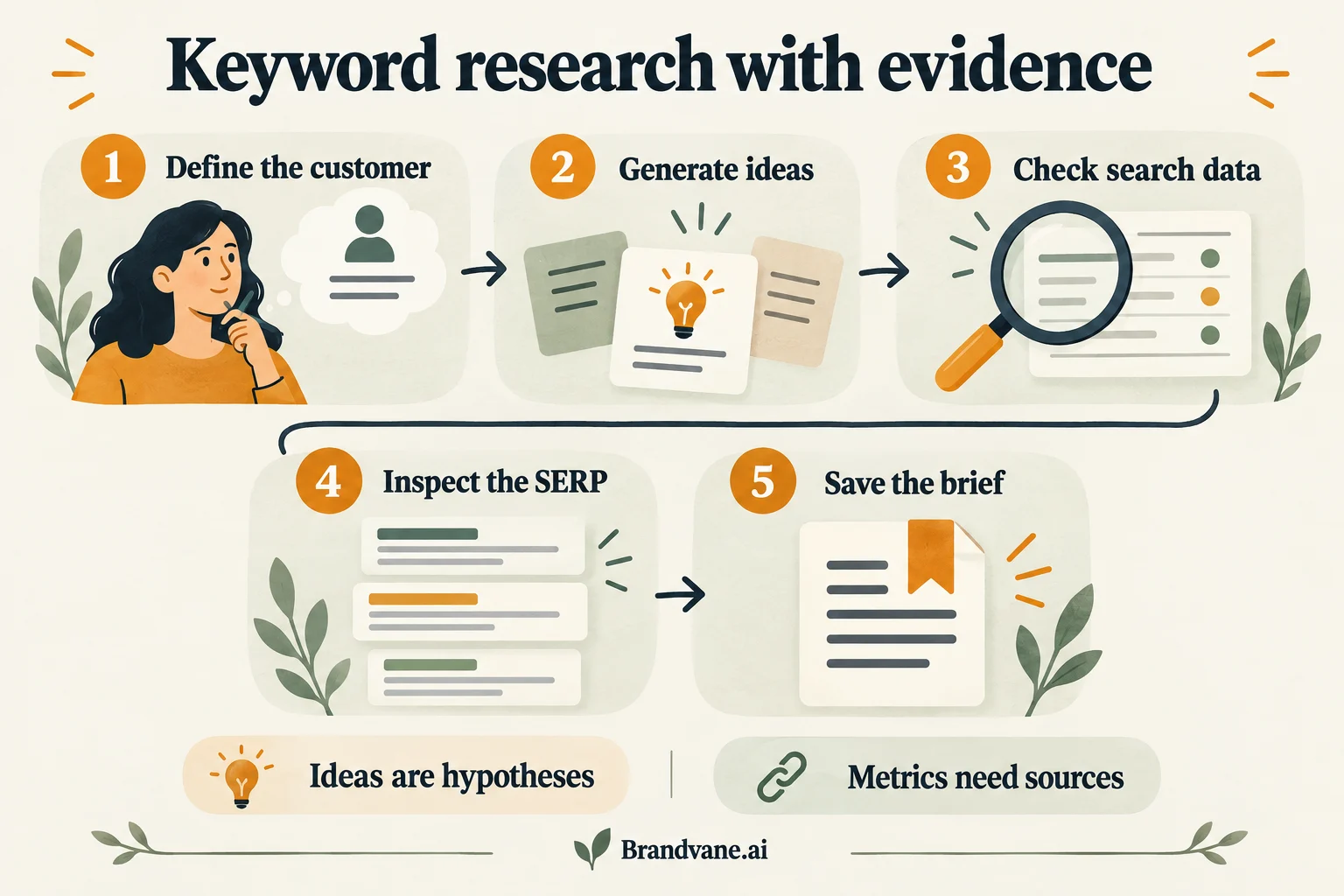
How to use these ChatGPT keyword research prompts
Start with your business context, then supply a keyword export or approve a scoped research request. Give each prompt the files it needs and ask for a specific output: a shortlist, a keyword-to-page map or a content brief. Review the result before moving to the next step.
For reusable prompts covering titles, content reviews, internal links and audits, use our SEO prompt library for ChatGPT and Claude. This walkthrough focuses on the research that comes before choosing a page.
1. Give ChatGPT the business context
Start with what you sell, who buys it and where you can serve them. Include constraints that would make a keyword irrelevant. A shop that sells finished lamps should not accidentally build its whole plan around electrical repair instructions.
I sell handmade wooden desk lamps to US customers.
Customers care about small workspaces, warm lighting and gifts.
Suggest 12 keyword ideas grouped by buying, comparing and learning.
Exclude lamp repair services and wholesale supply.
Do not invent search volumes, difficulty scores or ranking claims.
Read the output as a list of hypotheses. Remove phrases for products you do not offer or questions you cannot answer responsibly. This is often a better first filter than choosing whichever phrase sounds most popular.
2. Add sourced keyword data
If you already have an export, give ChatGPT the keyword, country, volume, difficulty and source-date fields. Ask it to preserve missing values. Blank difficulty does not mean zero difficulty, and a zero-volume estimate does not establish that nobody searches for a topic.
A useful follow-up prompt for an uploaded export is:
Using this keyword export and my business context, return:
keyword | supplied volume | supplied difficulty | business fit |
provisional intent | evidence still needed.
Preserve the source, country and dates. Keep missing values unknown.
Exclude irrelevant topics and explain why. Do not add volumes across
close variants or infer search intent from volume alone.
For research through Brandvane, complete the ChatGPT connection setup and start with:
Quote Brandvane keyword research for "wooden desk lamp" in the US.
Show the cost, result limit and data source.
Wait for approval before running the request.
After reviewing the quote, approve only the proposed request. Brandvane currently returns up to 25 related keywords for five SEO credits; a provider may return fewer. Assistant access and usage are separate from the Brandvane plan.
Provider metrics are not interchangeable. For example, Ahrefs explains that its difficulty score uses referring domains to top-ranking pages and excludes on-page factors. Preserve each provider’s labels rather than silently merging different scores into one scale.
3. Inspect the search results before choosing a page
Shortlist a few phrases that describe a useful customer task. Ask for a separate quote to inspect their Google results, and approve the checks you need. A keyword suggestion report does not automatically include a SERP review.
Read the results for the specified market. Are they mostly stores, comparison guides, tutorials, videos or local services? A title can suggest a page’s purpose, but open the page before concluding what it covers. Record the exact URL where available and flag unresolved redirects.
If product listings dominate, a good category page may serve the reader better than an article. If detailed comparisons dominate, the page needs explicit selection criteria. This relationship between the query and the expected content is search intent.
4. Group related keywords by the page they need
Phrases can sound similar and still call for different answers. “Wooden desk lamps” and “best wooden desk lamp for a small desk” might support a collection page and a comparison guide respectively. Treat that distinction as provisional until you inspect their results.
Conversely, spelling variations and closely related phrasings may belong on one useful page. Repeated ranking URLs across two result sets are evidence to consider when clustering them, not an automatic rule.
Using the supplied keyword and SERP evidence, propose one page
for each distinct customer task. Give each page a primary phrase,
supporting phrases and a reason for the grouping.
Separate observations from your interpretation.
Do not add search volumes across overlapping keyword variants.
Use related phrases in sections where they help answer the question. There is no reason to repeat every variant in the title or write a separate article for each wording.
5. Turn the strongest cluster into a brief
The deliverable should tell a writer what to make and why. Ask for:
- Reader and task: who needs the page and what decision they will make.
- Page type: product page, comparison, tutorial or another justified format.
- Evidence: source, market, retrieval date, observation date when supplied, and coverage limits.
- Outline: sections that resolve the task, including unanswered questions from the research.
- Original contribution: a product demonstration, photographs, a worked example or first-hand explanation you can provide.
- Next step: a relevant product, service or additional guide.
Avoid treating a competitor’s outline as your assignment. Inspecting a page helps identify reader expectations; your article still needs its own useful explanation and evidence.
See the worked example from our own small-business research for the actual evidence-to-page decision, including missing metrics and different observation dates. The same guide includes a downloadable planning worksheet.
Keep the research after the conversation
Download the completed result from Brandvane’s Recent research using CSV or Brief .md. You can also ask the connected assistant to export a saved result. These exports do not start new research. Historical records can lack metadata that was never stored; an assistant should not fill it in from a guess.
Keep the final content brief alongside its source files. When you revisit the decision, you can distinguish a change in search results from a change in your interpretation.
The same process can be used with a compatible Claude or Codex connection. See the SEO MCP guide for how the assistant and research tools fit together, or follow the broader small-business keyword research process to choose your first pages.