You cannot find every AI citation for a website across every private answer. No public search operator or commercial tracker can observe all prompts, users, modes, locations, conversations, or future responses.
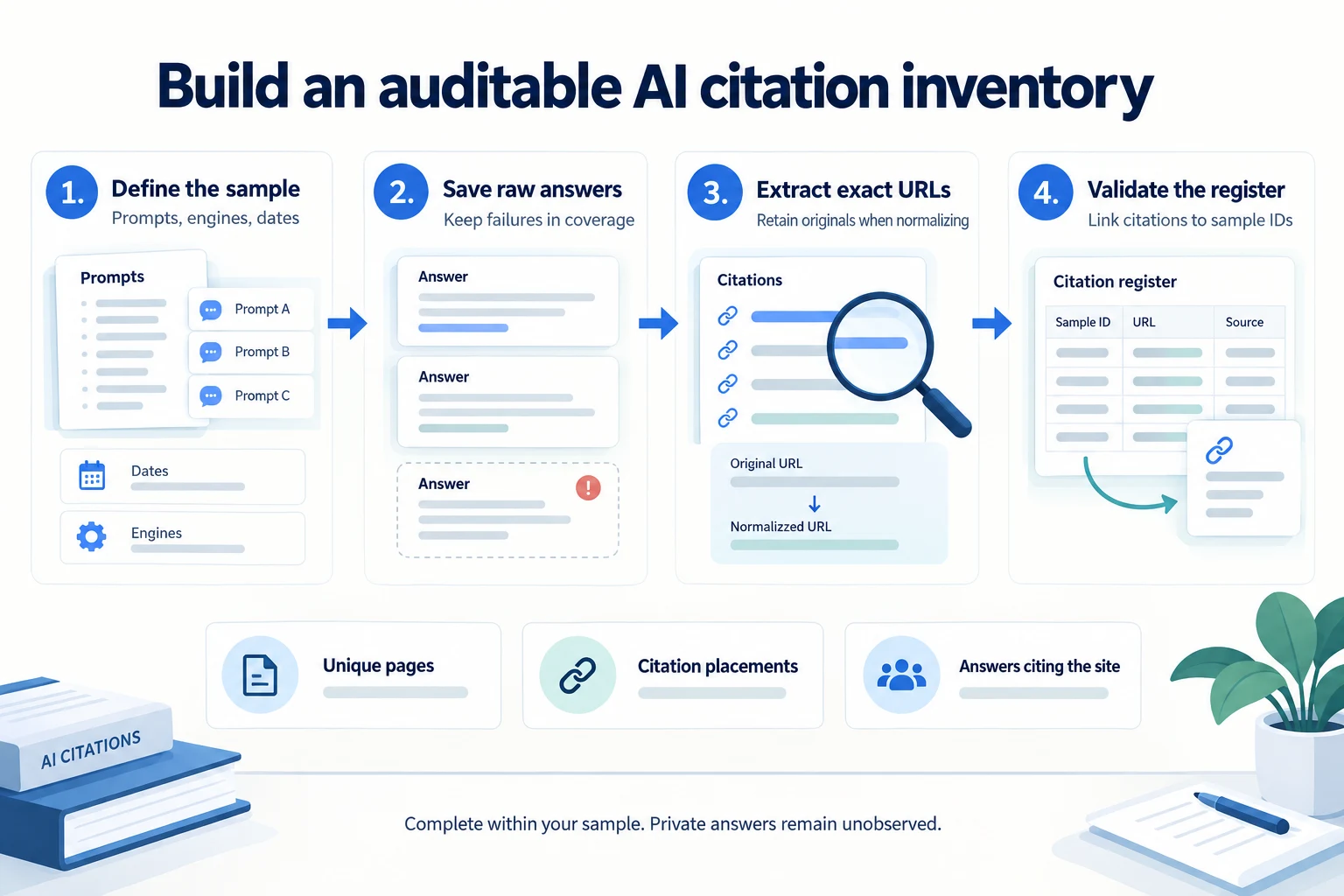
You can find every citation inside a disclosed sample. Define the engines, questions, repetitions, and date window; retain every completed answer; extract every cited URL; and report what the collection did and did not cover.
That narrower inventory is auditable. “We found all citations in 23 completed answers from this panel” is a meaningful claim. “We found every AI citation on the web” is not.
Decide what “every” means before collecting
Write a coverage statement with five boundaries:
- Website: the canonical domain and any subdomains or alternate domains included.
- Questions: the exact prompt panel and version.
- Answer surfaces: the products or engines sampled.
- Repetitions: how many answers were planned for each prompt and engine.
- Window: collection dates, times, and relevant location or mode settings.
Brandvane’s current subscription fresh checks sample OpenAI on demand. Automated weekly AI reports for ChatGPT and Google AI Overviews are coming soon. API answers and observations of consumer products must be labeled separately; neither provides access to every private answer.
The final claim can then be explicit:
This register contains every citation extracted from the completed answers in the disclosed panel and window. It does not contain citations from unobserved private answers.
Build questions around the buyer journey
A domain citation search is only as useful as the questions it covers. Include prompts from several decision stages:
- problem and category discovery;
- method or implementation questions;
- product and alternative comparisons;
- audience- or use-case-specific recommendations;
- objections, risk, compatibility, and evidence checks; and
- branded questions, kept separate from unaided discovery prompts.
Use customer interviews, sales calls, support questions, site search, search-query data, referral landing pages, and existing research to propose the panel. These inputs suggest useful questions. None reveals a complete log of what people ask an assistant.
Give every prompt a stable ID and store the exact text. A meaningful edit creates a new version. Otherwise a trend can look continuous while measuring two different questions.
Collect answers with an evidence trail
For each planned sample, retain:
| Field | Purpose |
|---|---|
| Sample ID | Connects the answer to its citations |
| Prompt ID and text | Preserves the actual question |
| Engine, product, model, or mode | Describes the instrument |
| Run time and controlled market | Defines the observation |
| Status | Keeps failures and blocked runs visible |
| Raw answer | Supports later classification review |
| Brand and competitor appearances | Separates mentions from citations |
| Displayed citation URLs | Provides the primary source record |
Important questions should be repeated under comparable conditions. One run can find a real citation, but it cannot show whether the citation is stable. Repetition makes variation visible without eliminating it.
If an answer fails, record the failure. Citation incidence uses completed answers in its denominator, while a separate coverage line reports completed out of planned samples.
Extract exact URLs before aggregating domains
Create a second table with one row per displayed citation and connect it to the sample ID. Keep:
- the URL exactly as displayed;
- resolved and canonical URLs when checked;
- registrable domain and subdomain;
- page path;
- whether the domain belongs to the audited website;
- the statement or section supported by the citation; and
- redirect, access, freshness, or review notes.
Normalize for analysis, but never overwrite the raw evidence. Two URLs might resolve to one canonical page; one URL might redirect somewhere unexpected; a tracking parameter may explain an apparent duplicate.
Define the domain rule in advance. Decide whether documentation, help-center, application, and country subdomains count as the same website. Do not change the rule after seeing the result.
Deduplicate at the right level
There are three useful counts, and they answer different questions:
- Unique cited URLs: How many distinct pages from the website appeared?
- Answers citing the website: In how many completed answers did at least one own-domain URL appear?
- Displayed citation links: How many citation placements pointed to the website?
For incidence, use answers citing the website out of completed answers. One response that links to the same domain five times remains one source-containing answer. Preserve the five placements when reviewing which claims and pages were used.
Do not merge brand appearance into own-domain citation. The answer can name a company and cite a third party, or cite company documentation for a fact without recommending the company.
Validate the inventory
Before calling the panel complete, reconcile five checks:
- every completed sample has a raw answer;
- every displayed citation in each raw answer has a citation row;
- every citation row points back to a sample;
- planned, completed, failed, and unusable totals reconcile; and
- domain normalization follows the declared rule.
Then manually review edge cases: shortened URLs, redirectors, duplicate canonicals, embedded citations, inaccessible pages, and citations whose visible label does not match the resolved domain.
Automation can accelerate extraction, but a human should inspect ambiguous citations and the answer context. A domain string alone does not tell you what the source supported.
Produce a useful citation-gap report
The final inventory should lead with coverage, not a score:
- planned and completed samples by engine and prompt cluster;
- answers citing the audited domain out of completed answers;
- the audited URLs cited, with their answer and prompt counts;
- recurring third-party sources in brand-absent answers;
- competitors appearing with and without supporting citations;
- the claim or buyer need each recurring source addressed; and
- collection failures, instrument changes, and missing data.
The action queue should stay attached to evidence. “Publish more thought leadership” is vague. “Test a current compatibility page because 4 of 7 completed implementation answers cited third-party documentation for that exact requirement” is specific and falsifiable.
What backlink tools, logs, and GA4 add
A backlink index can reveal links between public web pages. It does not identify which generated answers displayed them. Server or edge logs can show verified infrastructure requests. They do not prove an answer cited the page. GA4 can record human visits referred by recognizable assistant sources. It cannot see an unclicked citation or reconstruct the answer behind every visit.
Keep the events separate, then reconcile them. How Brandvane measures AI visibility explains why sampled answers, verified access, and AI-referred human visits require different claim language.
What a citation audit cannot promise
An audit cannot observe private answers it did not sample, recover all real-world prompt frequency, guarantee that a citation will repeat, or prove that a page change caused the next result. Even an exhaustive review of the chosen panel remains one bounded panel.
That limitation does not make the work pointless. A complete register for a disclosed sample can identify exact pages, recurring third-party sources, missing evidence, and the baseline needed for a later test.
For the evidence framework, see how Brandvane measures AI visibility. Automated weekly AI reports for ChatGPT and Google AI Overviews are coming soon; the planned reports will keep the two surfaces separate and show completed-check counts.
The honest answer
You cannot find every AI citation for a website everywhere. You can define a relevant sample, capture every answer it returns, extract and validate every citation inside it, and make the coverage legible. That is the difference between an impossible completeness claim and an inventory a skeptical client can audit.