No checklist can guarantee more AI citations. Generated answers vary, source selection changes, and no site owner controls what an assistant will cite.
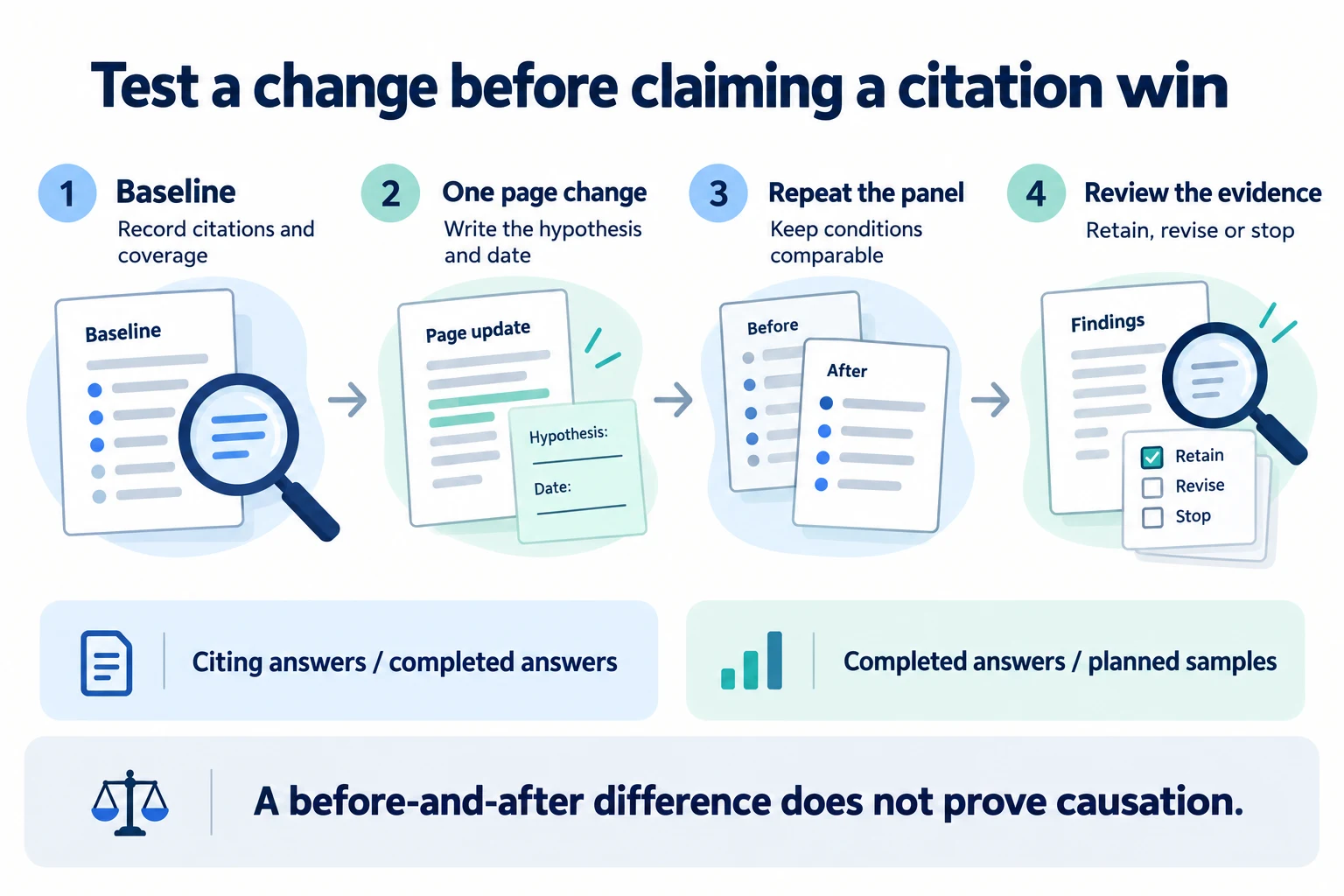
You can run tests. Establish a baseline for a fixed set of buyer questions, make one evidence-driven change, repeat the sampling under comparable conditions, and report whether citation incidence changed out of the completed answers.
For the strategic boundary around that work, AEO versus SEO explains what generated-answer optimization adds to an existing search program—and which foundations do not change.
Every item below is phrased as a test because the observable outcome—not the tactic’s popularity—should decide what happens next.
Set up the experiment before changing the page
Choose one prompt cluster and record:
- exact prompt text and version;
- sampled engines and modes;
- planned repetitions and collection dates;
- completed and failed answers;
- answers citing your domain out of completed answers;
- exact own-domain and third-party URLs cited; and
- brand and competitor appearances.
For an independently run test, you might repeat priority questions three times per chosen engine in a measurement wave. This is a sampling-design choice, not a Brandvane subscription schedule or a guarantee of statistical completeness.
Brandvane’s SEO and Pro+ plans provide on-demand OpenAI API checks: one approved question and one answer per fresh-check unit. They do not include automatic weekly or multi-engine AI sampling. Provider-recorded mentions are a separate research source that uses SEO credits. Choose the scope and budget before repeating checks; see current AI features and plan limits.
Freeze unrelated changes during each test when practical. If multiple pages, prompts, and technical settings change together, a later citation change cannot identify which intervention mattered.
Test 1: put the direct answer in accessible HTML
Hypothesis: the page may be a weak candidate because its answer is hidden behind client-side interaction, a video, an image, or a long preamble.
Change: add a concise, accurate answer to the target question in server-rendered HTML near a descriptive heading. Preserve the deeper explanation and evidence below it.
Observe: verify the text in the initial HTML, confirm the live URL returns successfully, then compare answers citing that URL out of completed samples before and after the change.
Decision: retain the structure if citation incidence or source-context relevance improves across later comparable samples; otherwise investigate access, evidence, and intent before producing more of the same format.
Test 2: make the claim traceable to primary evidence
Hypothesis: a page asserts a useful fact but does not show where it came from, how it was measured, or when it was checked.
Change: attach the claim to the primary source, first-party dataset, method, date, unit, and relevant limitations. Remove unsupported precision.
Observe: inspect whether later sampled answers cite the page for that specific claim, whether they continue citing another source, or whether neither source appears.
Decision: keep the evidence block if it makes the claim easier to verify even when citation incidence does not change; revise the test if the sampled answers need a different fact.
Test 3: answer the recurring source gap
Hypothesis: a third-party page recurs because it answers a buyer subquestion your site leaves unresolved.
Change: review the exact claims supported by the recurring source, then publish or improve an original page that answers the legitimate missing need. Do not copy the source or imitate its wording.
Observe: count answers citing the recurring source and your new or revised URL out of the same prompt-cluster denominator in later samples.
Decision: continue only if the page genuinely improves buyer decision support. A citation shift may justify more work; no shift should trigger a review of intent and evidence, not an automatic rewrite.
Test 4: clarify entity and product facts
Hypothesis: assistants and cited sources encounter inconsistent names, categories, audiences, prices, locations, or product descriptions.
Change: reconcile factual contradictions across the page title, opening copy, about page, product pages, organization details, and relevant structured data. Use only facts the business can substantiate.
Observe: review later answers for factual consistency, correct brand identification, and own-domain citation incidence. Record corrections separately from recommendations.
Decision: keep accurate consistency improvements regardless of citation movement; do not manufacture third-party consensus or inflate claims to force inclusion.
Test 5: expose comparison criteria, not a self-serving verdict
Hypothesis: buyers ask comparison questions, but the site offers only promotional claims or an unexplained “best” label.
Change: publish a dated comparison organized around decision criteria, who each option fits, verified differences, and explicit unknowns. Disclose ownership and conflicts. Link claims to primary sources.
Observe: sample the neutral comparison prompts again and record whether the page is cited, which section supports the answer, and whether factual errors decrease.
Decision: update the page when source facts change. Do not interpret one favorable recommendation as a permanent rank or proof that the comparison caused it.
Test 6: repair indexability and fetch failures
Hypothesis: the useful page is unavailable to relevant retrieval systems because of a status error, robots rule, authentication barrier, canonical conflict, or rendering dependency.
Change: fix the specific verified fault without relaxing controls unrelated to public discovery. Confirm the canonical URL, status, robots directives, rendered content, and sitemap entry.
Observe: use server or edge evidence where available to confirm later requests and successful responses; separately measure whether the page appears as a citation in later answer samples.
Decision: call the technical repair successful when access works. Do not call it a citation success unless the citation event is also observed.
Test 7: replace stale facts with a dated review
Hypothesis: a page is skipped or misused because material facts are old, undated, or contradicted by current primary sources.
Change: recheck each time-sensitive claim, add the review date, correct changed details, and label facts that remain unverified. Preserve a visible update note.
Observe: compare which URLs and facts later answers cite, and manually verify whether the surrounding claims are more current and accurate.
Decision: retain the maintenance cadence that keeps buyer-critical facts correct. Do not claim that changing a date alone earns citations.
Test 8: strengthen a legitimate third-party record
Hypothesis: sampled answers repeatedly rely on an eligible directory, standards body, partner page, or industry source where the brand’s record is missing or inaccurate.
Change: correct the profile or contribute verifiable evidence through the source’s normal editorial process. Do not buy deceptive placements, fabricate reviews, or seed undisclosed promotional claims.
Observe: track whether the third-party record is corrected, whether it appears in later citations, and whether the brand appears in the same completed answers.
Decision: judge the update first on factual accuracy and buyer usefulness. Treat any citation movement as a sampled observation, not an entitlement created by the placement.
Test 9: improve the answer page’s internal evidence path
Hypothesis: the page gives a concise answer but leaves supporting methodology, specifications, or original research disconnected.
Change: add descriptive internal links from the answer to the strongest relevant first-party evidence, and link back from the evidence to the decision page where useful.
Observe: record whether later answers cite the decision page, the evidence page, both, or neither, and whether the citation supports the intended claim.
Decision: keep the links when they improve human navigation and traceability. Do not add repetitive links solely to manipulate a citation count.
Test 10: narrow the page to one question it can answer best
Hypothesis: a broad page touches many topics but gives no complete answer to the prompt cluster being sampled.
Change: consolidate true duplicates and create one focused page only when the question requires distinct evidence or instructions. Give it a specific title, direct opening, and complete method.
Observe: compare citations by exact URL and prompt cluster after indexing and an appropriate sampling interval. Watch for cannibalized or split citations across near-duplicates.
Decision: retain the focused page if it resolves a distinct buyer need. Merge it back when the evidence and intent overlap with an existing canonical page.
Read the result conservatively
For every test, report:
- the baseline citation count out of completed answers;
- completed out of planned samples;
- the exact change and publication date;
- the later citation count out of completed answers;
- engine and prompt-cluster breakdowns;
- other known instrument or site changes; and
- whether referrals, access, or business outcomes changed in their own lanes.
A before-and-after pattern is not automatically causal. Assistants vary between runs, the web changes, and other sources can enter or leave the retrieval set. Repetition and stable conditions make the test more interpretable; they do not prove causation.
For the evidence framework, see how Brandvane measures AI visibility. Automated weekly AI reports for ChatGPT and Google AI Overviews are coming soon; the planned reports will keep the two surfaces separate and show completed-check counts.
The checklist’s real promise
This process does not promise more citations. It promises a better decision: each change begins with a documented gap, ends with an observable outcome, and can be retained, revised, or stopped without inventing a success story.